 DeMAP
Sign in
Start free
Why one answer is not enough
The same question can need a different answer depending on who asks it. A recruiter wants a clear story, and a senior engineer wants the trade-off. So DeMAP gives you nine styles and lets you switch without losing what you had.
The technical styles
| Style | What you get | Use it when |
|---|---|---|
| Theory | The idea in plain words: what it is, when to use it, when not to, and the one thing to get right | They ask what something is or why it matters |
| Examples | The same explanation with a real-world example | You want the idea to stick |
| Code | Working code, a reason on the lines that matter, and the time and space it costs | They ask you to write it |
| Both | A short explanation first, then the code, without saying anything twice | They want you to talk it through and build it |
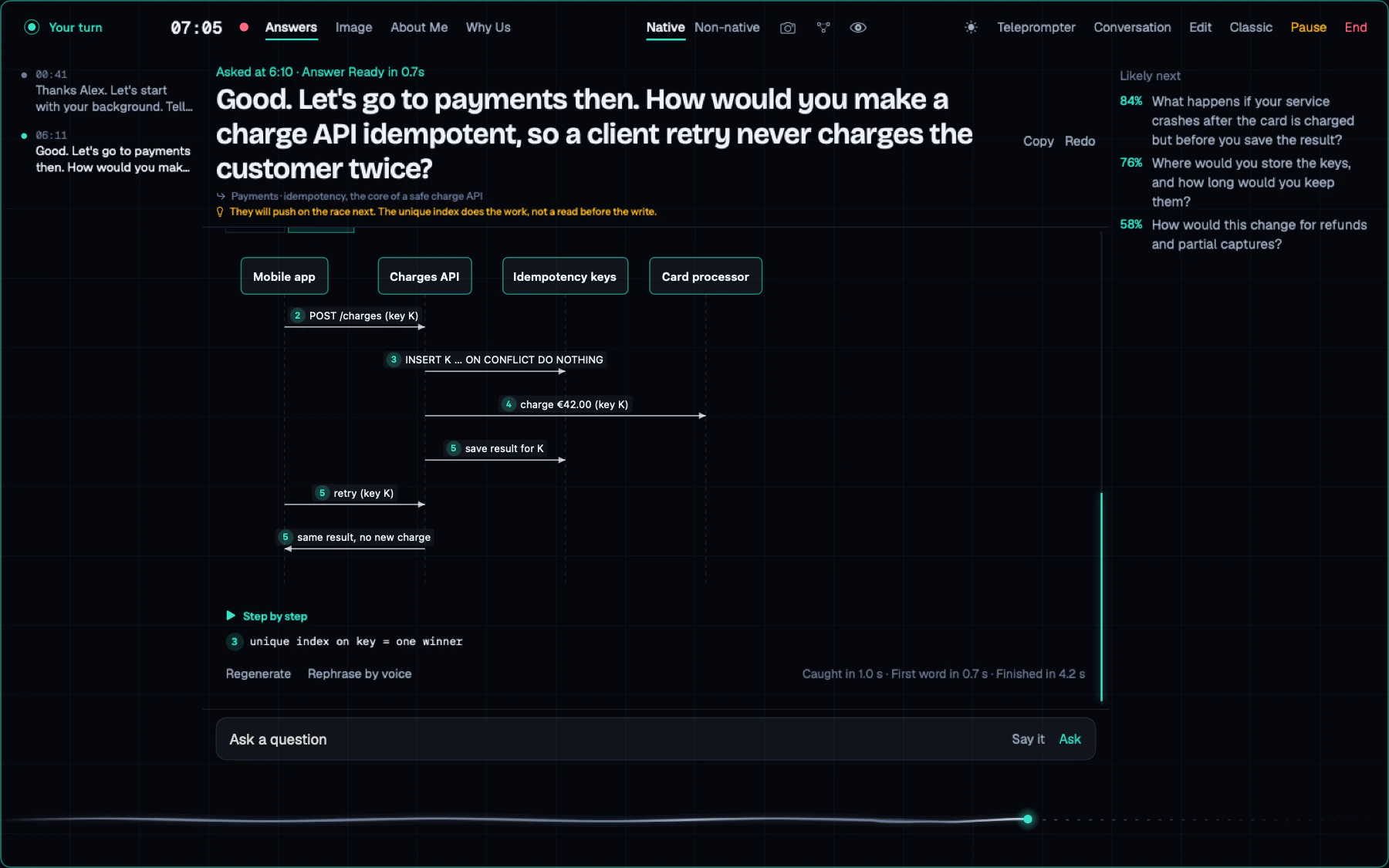
| Design | Numbered talking points, the diagram to draw step by step, and the follow-ups | The question is about architecture |
The story styles
These four use a real project from your resume.
| Style | What you get | Use it when |
|---|---|---|
| STAR | A story told as speech: the situation, your task, what you did, how it ended | They say "tell me about a time" |
| CARL | Challenge, action, result and learning, with a thirty-second version on top | They care what you learned |
| WWW | What you built, why it was needed and when it happened | They ask about a project on your resume |
| Project | How you used it in real work at your most recent company, with the trade-off it cost | They ask if you have used a tool |
General meetings have every style except Code and Both.
When none of them fits
Simpler and Another way list every approach to the question, easiest first. Pick one and it is written under the first answer, so you can compare them.
Common questions
Do the story styles invent examples?
No. They use a real project from your resume, and the prompts forbid inventing companies, tools or figures.
What is the difference between STAR and CARL?
STAR ends on the result. CARL adds what you learned, which suits questions about failure and growth. Read the full comparison.