 DeMAP
Sign in
Start free
A plan for the time
| Minutes | Step | What to say |
|---|---|---|
| 0 to 5 | Clarify | Who uses it, what it must do and what scale you expect |
| 5 to 10 | Estimate | Rough traffic, storage and the numbers that drive the design |
| 10 to 25 | Design | The main components and how a request flows through them |
| 25 to 40 | Go deep | The hardest part, the bottlenecks and how it fails |
| 40 to 45 | Wrap up | Trade-offs, and what you would do next |
What interviewers look for
- You ask before you draw.
- You name the trade-off in each decision.
- You change your design when the requirement changes.
- You know where it breaks and how you would notice.
Common mistakes
- Starting with a tool name in place of a requirement
- Drawing boxes without showing how data flows
- Going deep on an easy part and running out of time
- Defending a choice after the interviewer has shown a flaw in it
How DeMAP helps
Practise the structure out loud with Interview Practice, which covers system design as one of its scored areas.
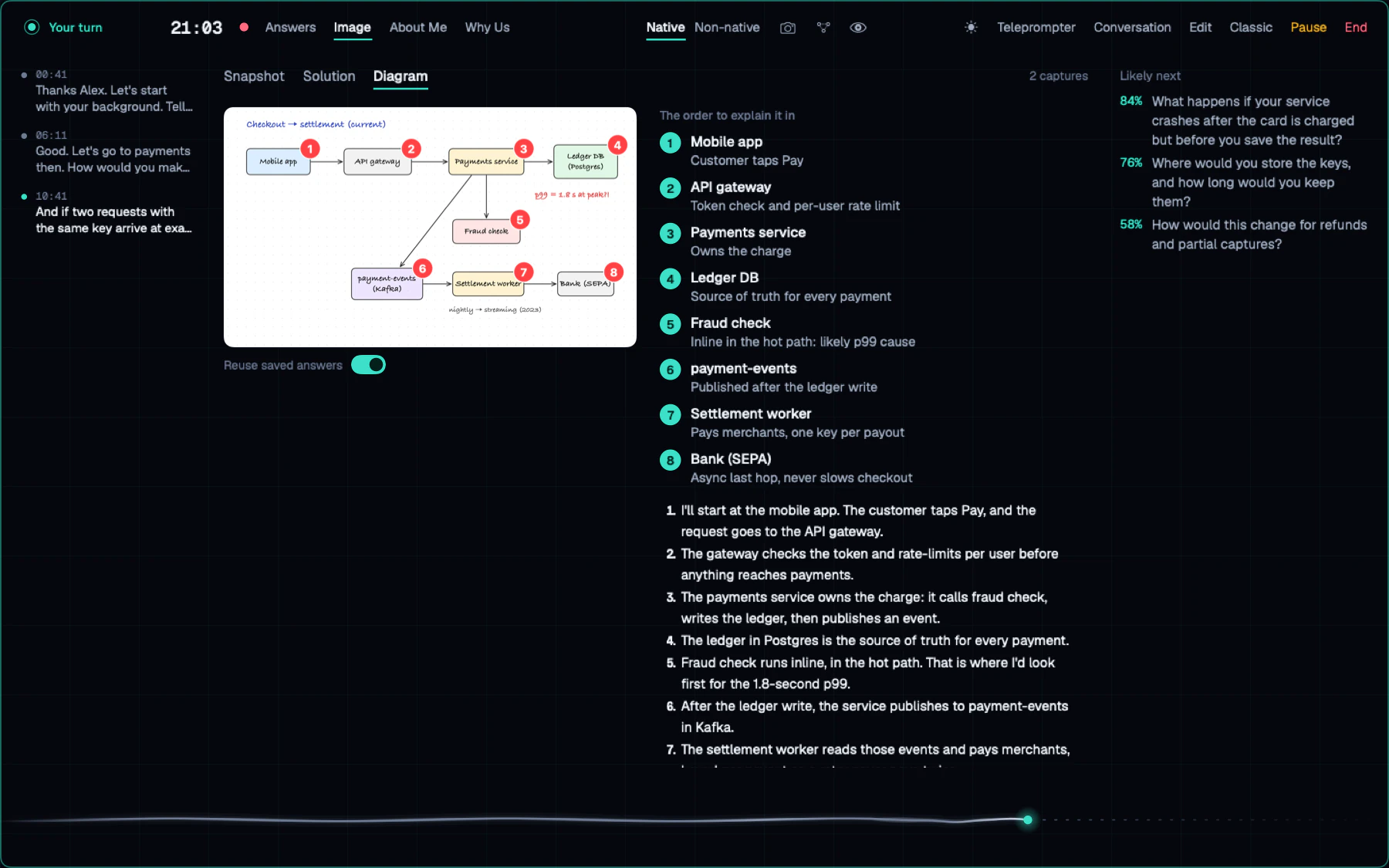
In a live meeting, a Design answer gives numbered talking points, the diagram to draw step by step and likely follow-ups. On the Yearly plan, Diagram capture numbers an architecture drawing in the order to explain it, with what to say at each number.
Common questions
How should I handle a question I have never seen?
Clarify first. A new problem usually breaks down into parts you know: storing data, moving it and keeping it correct.
How much detail should I go into?
Follow the interviewer. Give the high-level design first, then ask which part they want to explore.